A freight elevator changes material movement only when its car, doors, loading method, controls, and surrounding circulation match the way goods actually enter, travel through, and leave a building. By mapping that process and measuring its peak demand, you can compare capacity, layout, elevator type, and operating controls before committing to equipment.
Key takeaways
- Map goods from dock to destination before choosing elevator capacity.
- Specify cabin dimensions, door size, load height, and pallet clearances.
- Match elevator speed, controls, and layout to peak delivery patterns.
- Compare quotes using throughput, dwell time, safety, and loading details.
Map the material journey from receiving dock to destination floor
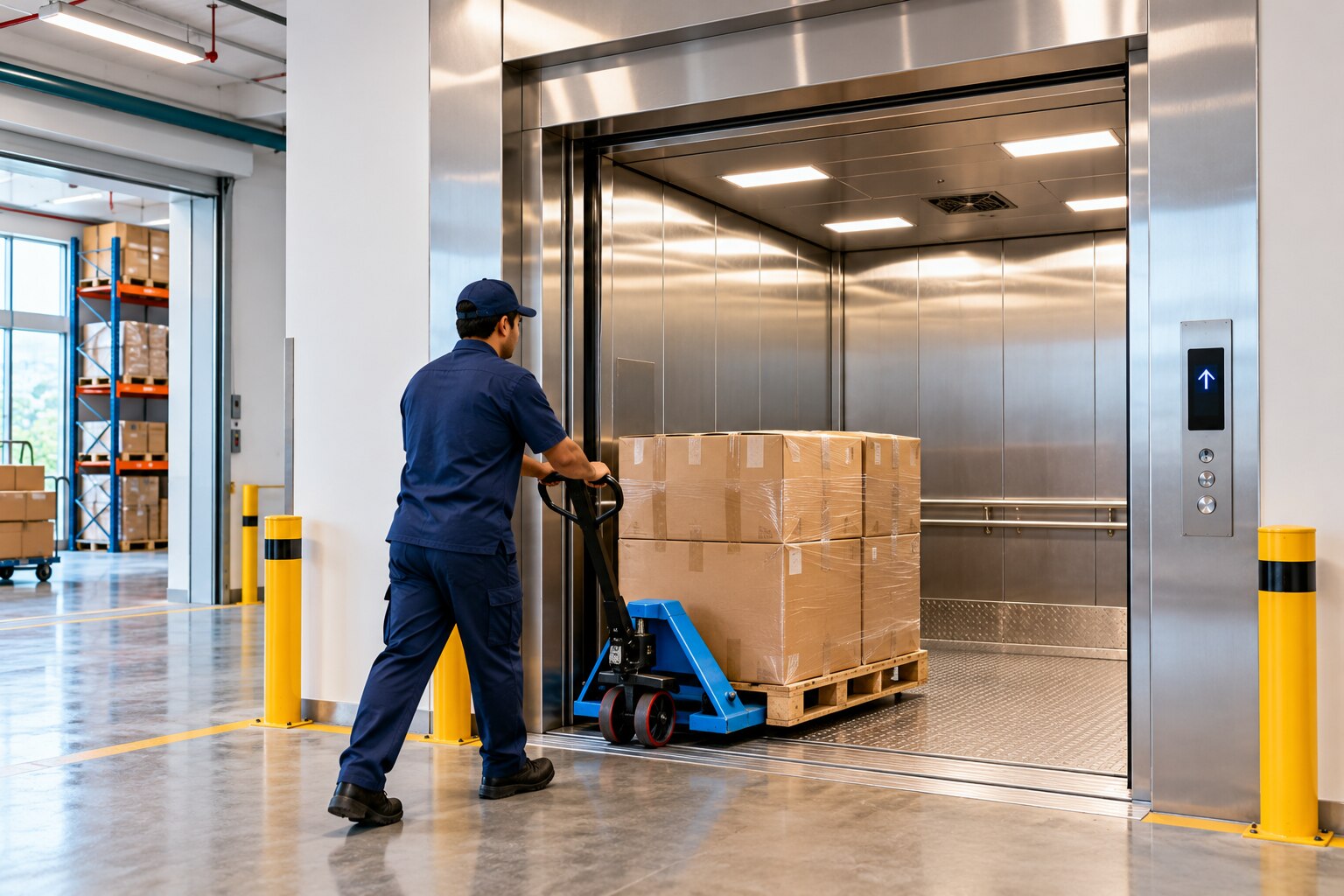
At the receiving dock, goods move into a controlled route rather than an improvised trip through passenger areas. Staff check the delivery, place pallets or roll cages in a marked waiting zone, and call the freight elevator only when the load is ready.
1. Position the pallet truck, trolley, forklift, drums, or crates beside the level dock interface. Bollards protect the landing, while a load-ready signal prevents the car from waiting empty.
2. Enter the car squarely, keeping the load within the clear door opening and away from the sill gap. A forklift operator must follow powered-industrial-truck controls, including neutral controls, applied brakes, and secured wheels when required.
3. Dispatch the load to storage floors, production floors, or another designated level using a booking rule that prevents competing teams from claiming the same cycle.
4. Unload into a marked receiving bay on the destination floor, then return the car for the next scheduled movement instead of leaving it occupied during unpacking.
This sequence exposes the real gain: less carrying, fewer route conflicts, and predictable handoffs between floors. The elevator still becomes a bottleneck if loading, unloading, door operation, and dispatch delays consume most of each cycle. Staging often improves material movement more than a modest increase in travel speed.
Specify the complete loading envelope, not just a kilogram rating
A 4,000 kg rated load does not make an elevator suitable for a 4,000 kg shipment. Calculate the heaviest complete lift: goods weight plus pallet weight, trolley weight, and operator weight.
The rated load must exceed that total under the intended loading class, with the load distributed within the car’s permitted floor loading and centre-of-gravity limits.
Record these design inputs before requesting a quotation:
- Maximum pallet, crate, drum, roll cage, or machine dimensions, including overhang
- Combined loaded weight and the wheel loads from pallet trucks, forklifts, or trolleys
- Car width and depth, clear door width and height, and the turning radius needed to enter, rotate, and exit
- Sill height and gap, floor-to-floor travel, headroom, and pit depth available in the shaft
- Required floor strength, point-load rating, and protection for impacts from wheels or forks
Measure the longest and widest load, not the average one. A pallet that fits diagonally on paper can still fail at the doorway because the trolley handle, operator, or turning arc strikes the jamb. Allow space for people to stand clear without placing an operator between a moving load and the car wall.
State the loading method explicitly: hand loading, pallet truck, forklift, roll cage, or another vehicle. ASME A17.1 freight-elevator loading classes distinguish these practices, and a proposal that lists only rated load leaves door protection, floor loading, and safe access unresolved.
Match the elevator type and technology to the building layout
Choose by traffic pattern, loading method, and travel height—not capacity alone. A 4,000 kg rating does not say whether industrial trucks, vehicles, or passengers are permitted; specify the ASME A17.1 freight loading class and coordinate landing doors, hoistway separation, recall, fire-service access, and any through-car arrangement with locally adopted codes.
| Option | Best fit | When it applies |
|---|---|---|
| goods-only lift | Dedicated freight movement | Use where pallets, trolleys, drums, or crates move between docks, storage, and production floors without passengers. |
| goods-and-passenger lift | Mixed people-and-goods traffic | Choose it when staff must accompany loads and separate freight capacity would waste space or time. |
| service lift | Back-of-house building circulation | Use for housekeeping carts, supplies, waste, or retail stock where a full freight car is unnecessary. |
| dumbwaiter | Small, light items | Choose between kitchens, laboratories, libraries, or service counters; it cannot replace a pallet lift. |
| vehicle lift | Cars or industrial vehicles | Use where a ramp is impractical; require a system designed for the vehicle size and keep occupants out unless specifically approved. |
| traction system | Taller travel or heavy traffic | Choose for multiple floors, frequent cycles, and higher speed; allow space for counterweights, drive equipment, ropes, and sheaves. |
| hydraulic system | Low-rise, force-intensive duty | Choose for short travel and strong starting force; allow for slower travel, cylinder access, hydraulic fluid, and pit conditions. |
A lift that suits the height can still fail the workflow. Match the car and doors to turning space, forklift entry, and load-ready staging; otherwise door dwell and positioning time will erase any speed advantage.
Design for peak throughput, safe loading, and low dwell time
Rated speed does not determine freight throughput. Door opening and closing, truck positioning, leveling, loading, unloading, and dispatch delays can consume more time than travel in a low- or medium-rise building. Measure the complete cycle and set a target for peak lifts per hour, not average daily tonnage.
Staging turns that target into usable capacity. Provide:
- A marked waiting bay beside the landing
- A level dock-to-sill interface
- Load-ready signaling or booking confirmation
- Bollards that protect doors and control panels
- A rule defining who may call and load the car
Without these controls, the elevator waits for a pallet, operator, or trolley while its rated speed contributes nothing.
Independent-service operation lets an authorized operator reserve the car for one delivery without normal hall calls interrupting it. It is not an unrestricted manual mode: door protection, interlocks, overload protection, emergency operation, and fire-service controls remain active.
Coordinate landing doors, hoistway separation, recall, and any through-car arrangement with the locally adopted elevator, building, and fire codes.
Maintenance protects the output you designed. Track door faults, leveling errors, extended dwell time, brake performance, and missed service intervals; one unreliable door can reduce peak lifts per hour more than a slower rated speed. Schedule inspections and repairs before receiving or dispatch peaks, when a failed car becomes a building-wide bottleneck.
Turn the workflow into a specification you can compare
Put the loading method at the centre of the elevator specification, not the rated mass. State whether operators load by hand, pallet truck, forklift, roll cage, or another vehicle; ASME A17.1 loading classes distinguish these practices.
A “4,000 kg capacity” line alone does not tell you whether the truck, turning movement, or impact loads are acceptable.
Require every supplier to price and document:
- Clear door width and height, car width and depth, headroom, sill gap, pit depth, floor-to-floor travel, and turning radius.
- Rated load calculated from goods, pallet, trolley or truck, operator, and load-centre effects.
- Through-loading, landing approach space, forklift securing procedure, and floor loading at the car and landings.
- Door cycle time, levelling tolerance, controls, dispatch logic, and designated staging areas.
- Landing-door fire and smoke coordination, recall, emergency operation, and fire-service access.
- Maintenance access, sill cleaning, door-impact inspection, interlock testing, alignment checks, and replacement-part availability.
Compare proposals on usable output, not speed alone:
| Brief item | Nominal quote | Usable specification |
|---|---|---|
| Capacity | 4,000 kg | Load, truck, operator, and load-centre calculation |
| Access | Standard doors | Longest pallet, turning path, through-loading, sill details |
| Service | Warranty stated | Inspection points, access, intervals, parts, response scope |
Firefox Elevators Private Limited can be asked to translate your measured workflow into this dimensional, operational, and maintenance schedule before comparing prices.
Related product
 | Elevators ₹700000 The Freight Goods Elevator is engineered for heavy-duty performance, designed to transport large and bulky goods efficiently. View product → |
Frequently asked questions
How should you map a freight elevator material journey?
Trace goods from the receiving dock through inspection, staging, elevator loading, floor travel, unloading, and the final destination. Mark waiting zones and keep passenger routes separate.
What loading details matter beyond freight elevator capacity?
Record rated load, cabin width, depth, height, door width and height, pallet dimensions, roll-cage clearance, floor loading, and the turning space available at each landing.
How do you match a freight elevator to a building layout?
Compare the building’s floor count, travel distance, shaft position, landing access, traffic pattern, pallet equipment, and delivery schedule with the elevator’s size, speed, controls, and door arrangement.
How can a freight elevator reduce waiting and improve throughput?
Prepare loads before calling the elevator, separate staging from travel paths, size capacity for peak periods, select suitable door and control systems, and measure loading, travel, unloading, and return time.