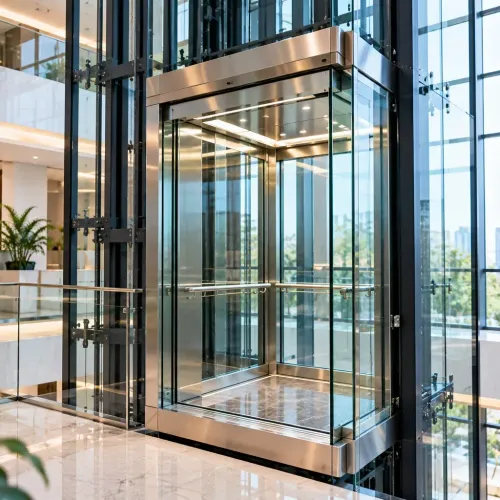
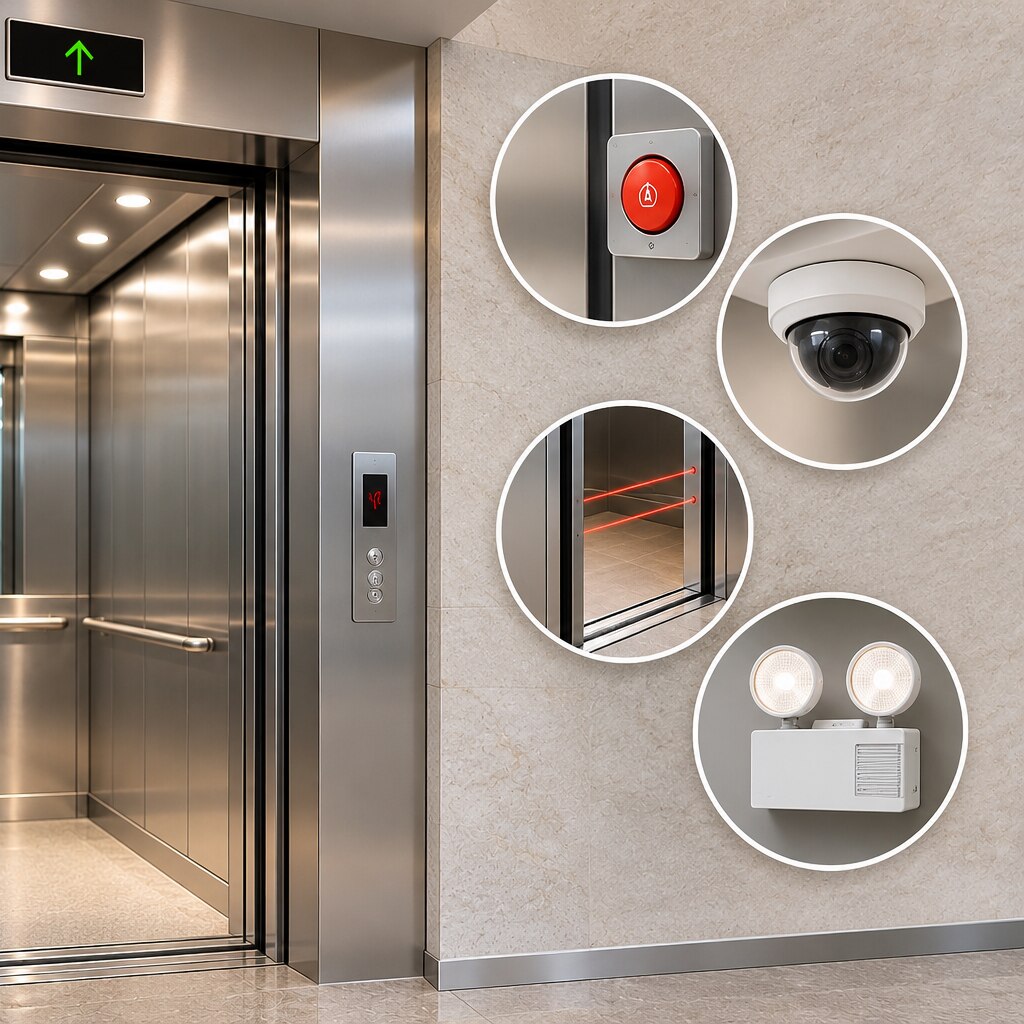
An elevator can have working doors and an alarm yet still lack protection against unintended movement, unlocked landing doors, overspeed, power loss, or unsafe maintenance access. By the end, you will be able to identify the essential safeguards, check whether they are being tested, request the right records, and assess safety before approving a modernisation project.
Key takeaways
- Check door interlocks, overspeed governors, buffers, and emergency brakes.
- Demand recorded safety tests, fault logs, and inspection certificates.
- Match fire, power, accessibility, and emergency features to building use.
- Audit shaft conditions, controls, wiring, and equipment before modernising.
Which elevator safety devices protect passengers and maintenance workers?
Look for protection against three distinct hazards: an open landing door, an uncontrolled car, and unsafe work in the shaft. A door sensor detects a person or object; a mechanical landing-door interlock prevents the elevator from running unless the door is locked.
| Device | Protects against | What to look for |
|---|---|---|
| Landing-door interlock | Car movement with an unlocked landing door | Mechanical locking and a contact; a contact alone is not enough |
| Overspeed governor | Excessive downward or upward car speed | Governor trip mechanism linked to the safety gear |
| Car safety gear | A falling or overspeeding car | Devices that grip the guide rails and stop the rated load |
| Unintended car movement protection | Car movement away from a landing while doors are open or unlocked | A separately specified UCM system, not merely an overspeed governor |
| Electromagnetic brake | Drive force failing to hold the car | A spring-applied brake that releases electrically and holds when power is removed |
| Buffers | Overtravel into the pit | Correctly rated buffers beneath the car and counterweight |
| Door-reopening device | A passenger being struck or trapped by closing doors | Detection across the opening, including the 5-to-29-inch zone |
| Emergency lighting and two-way communication | Darkness or inability to summon help | Battery-backed light and a working communication link |
| Car-top controls and pit protection | Maintenance-worker crushing, falls, or unexpected motion | Inspection controls, pit stop switch, lighting, ladder, and protected refuge space |
Also require phase-reversal protection and an automatic rescue device where specified. Test the governor, safety gear, interlocks, brake, communication, and rescue operation; never bypass a safety circuit to silence recurring faults.
How can you verify that the safety systems actually work?
A signed test record, not a parts list, proves that an elevator safety system works. Ask for the latest inspection certificate, maintenance log, breakdown log, code-required test reports, equipment manuals, and approval records from the local authority under applicable Indian elevator regulations.
- Run a door-reversal test with the specified obstruction. The door must reopen rather than crush or continue closing.
- Perform a door interlock test at every landing. The car must not move with a landing door unlocked, and the locked door must resist opening from the landing side when the car is elsewhere.
- Test emergency communication from inside the car. Confirm two-way voice contact and location or monitoring identification; an alarm bell or mobile phone is not enough.
- Test car-top inspection controls, pit stop switches, lighting, access ladder, refuge clearances, buffers, and machine-room equipment. Record defects, not merely attendance.
- Have a qualified inspector test the governor and safety gear at the prescribed speed and load. Check level accuracy, electromagnetic brake operation, phase-reversal protection, and automatic rescue operation where fitted.
| Evidence | What it proves | Weak substitute |
|---|---|---|
| Inspection certificate and test report | Required devices operated during a defined inspection | A certificate with no test results |
| Maintenance and breakdown logs | Repeated faults were diagnosed and corrected | Resetting faults or bypassing safety circuits |
| Signed communication and door records | Each landing and car function was tested | “Passed” with no locations or measurements |
Treat a bypassed interlock or recurring shutdown as a failed safety system. OSHA requires safety devices to remain operative; demand corrective work before returning the elevator to service.
How do elevator types and building uses change safety priorities?
A geared traction elevator uses a motor, gearbox, sheave, counterweight, brake, governor, and safety gear; its machine-room equipment needs guarding, isolation, and clear maintenance access. A gearless traction elevator suits taller buildings and higher speeds, but counterweight travel, overspeed protection, brake performance, and rescue access remain critical.
| Type | Main safety arrangement | Priority risk |
|---|---|---|
| Geared traction elevator | Mechanical brake, governor, safety gear, counterweight, machine-room disconnect | Brake or gearbox failure, overspeed, and unsafe machine-room access |
| Gearless traction elevator | Direct-drive traction machine, redundant braking, governor, safety gear, counterweight | High-speed overspeed, brake holding, counterweight clearance, and evacuation |
| Hydraulic lift | Pump, cylinder, check valve, rupture valve, buffers, and pit protection | Oil leakage, unintended descent, hose or pipe failure, and inadequate pit refuge |
| Machine-room-less elevator | Equipment in the shaft or hoistway, controller and disconnect access, governor and safety gear | Poor maintenance access, electrical isolation, guarding, and rescue work in confined spaces |
Building use changes the priority. In apartments, reliable door interlocks, entrapment communication, automatic rescue, and vandal-resistant controls matter most because trips continue at night. Hospitals need smooth levelling, reliable emergency power, stretcher clearance, and controlled recall. Warehouses require protection from impact, overloaded cars, and dust around doors and controls.
High-rise offices need evacuation planning, firefighter Phase II operation, standby power, and rescue procedures; firefighter operation does not make the elevator fireproof or permit ordinary passenger use during a fire. Confirm the actual car, counterweight, governor, buffers, pit ladder, lighting, stop switch, and refuge clearances during inspection.
What fire, power, accessibility, and emergency features must owners plan for?
Treat the elevator, generator, fire alarm, and accessible evacuation plan as one system. During a normal-power failure, emergency power must cover the elevators identified by the building and fire codes; do not assume every car will run on the generator. Emergency lighting, controls, alarm, and two-way communication also need a dependable standby supply.
- Firefighter operation begins with Phase I recall: the car leaves normal service and returns to its designated landing. Phase II operation then gives trained firefighters controlled manual operation through the firefighter service controls; it does not make the elevator fireproof or permit ordinary passenger use. Fire-rated landing doors, protected lobbies, shaft protection, smoke control, and generator capacity remain separate design obligations.
- Automatic rescue moves a stranded car to a landing and opens the doors after a power interruption, but it is not a substitute for firefighter operation or a tested emergency supply. Confirm that the rescue device, batteries, controller, and door operator are compatible.
- Provide two-way voice communication that a trapped passenger can use without a mobile phone and that identifies the car to a monitoring point. An alarm bell alone is inadequate.
- Preserve accessibility during normal service: accurate leveling matters as much as car size and automatic doors. The 2010 ADA Standards limit ordinary misleveling to 1/2 inch and re-leveling accuracy to 3/8 inch.
Test emergency lighting, communication, recall, manual firefighter controls, and automatic rescue under documented procedures. Never bypass a safety circuit to stop nuisance shutdowns; trace the fault instead.
What should you check before modernising an existing elevator?
A modernisation improves safety only when the new equipment matches the existing shaft, wiring, emergency systems, and maintenance capability. Measure shaft dimensions, pit depth, headroom, rail condition, machine supports, door openings, and car clearances before selecting equipment; a catalogue fit is not a site fit.
| Area | Check before approval | Failure if missed |
|---|---|---|
| Physical | Shaft dimensions, guide rails, landing entrances, pit, headroom, buffers, and car frame | New equipment fouls the structure or leaves unsafe clearances |
| Electrical | Supply capacity, earthing, phase sequence, safety-circuit wiring, emergency power, and controller compatibility | Nuisance shutdowns, lost emergency lighting, or defeated protection |
| Doors | Landing-door interlocks, locks, sill condition, door operator compatibility, and door-reopening tests | The car runs with an unlocked door or traps an obstruction |
| Operations | Fault history, levelling accuracy, alarm, two-way communication, inspection controls, and pit stop switches | A recurring fault is concealed instead of corrected |
Do not accept a jumper wire or bypass as a cure for shutdowns. Trace the fault history, wiring, door hardware, and required tests; OSHA requires safety devices to remain operative. Ask the supplier for:
- A compatibility schedule naming every retained and replaced component
- Controller, door operator, wiring, and emergency-power drawings
- Inspection certificates, test reports, manuals, maintenance and breakdown logs
- Confirmation of replacement parts availability, technician training, and local response
- A commissioning plan covering interlocks, overspeed protection, brakes, buffers, rescue operation, communication, and firefighter controls
Ask Firefox Elevators Private Limited to record these checks in the handover file, not merely quote replacement equipment.
Related products
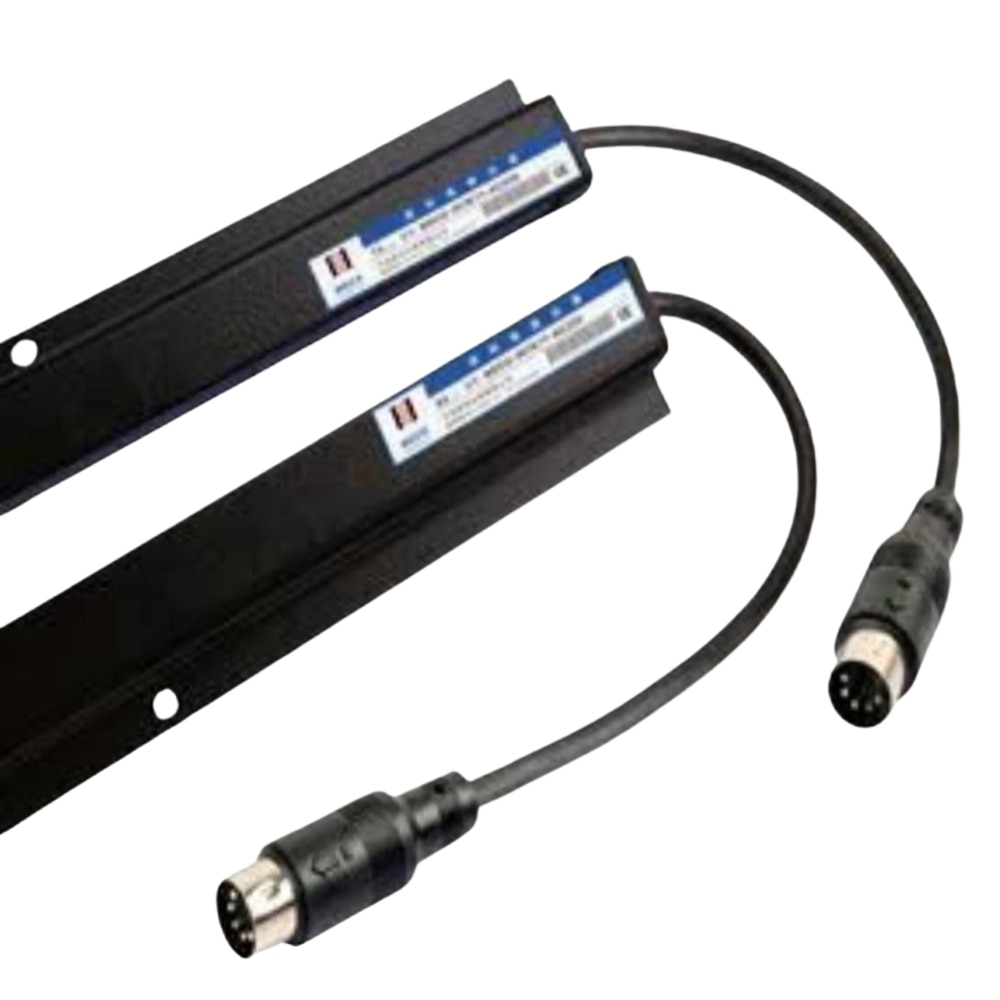 | Elevators ₹5900 Elevator Door Sensors are advanced safety devices designed to detect obstructions and ensure seamless door operation. View product → |
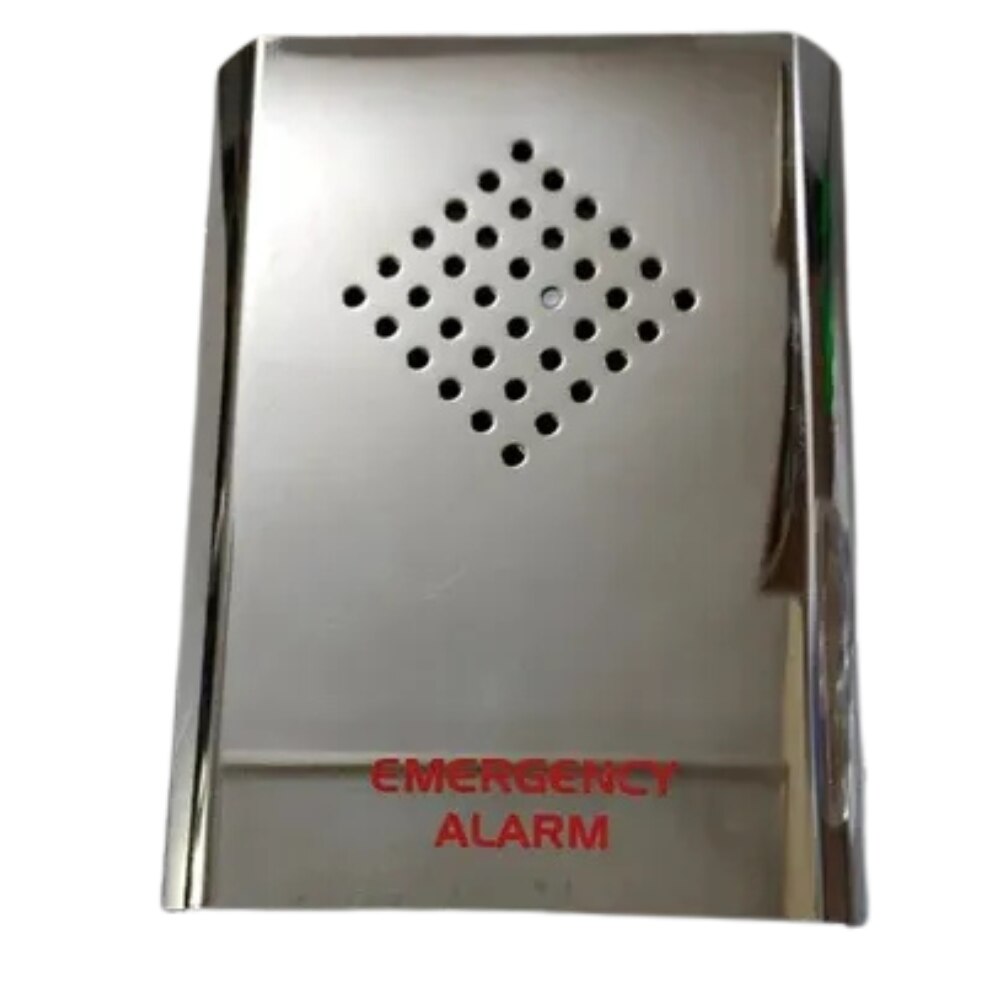 | Elevators ₹1200 The Elevator Alarm is a critical safety feature designed to alert in case of emergencies, ensuring passenger security and timely assistance. View product → |
Frequently asked questions
Which elevator safety devices protect passengers and maintenance workers?
Door sensors detect obstructions, landing-door interlocks stop travel with an unlocked door, and overspeed governors, safety brakes, and buffers protect against uncontrolled movement. Shaft guards, inspection controls, and lockout procedures protect maintenance workers.
How can you verify that elevator safety systems actually work?
Ask for dated inspection and test records, fault logs, maintenance reports, and certificates required by your local authority. Have a qualified elevator professional test door interlocks, emergency brakes, alarms, communication systems, and overspeed protection rather than relying on visual checks.
How do elevator types and building uses change safety priorities?
Passenger, goods, hospital, fire-service, and high-rise elevators face different risks. Consider traffic, load type, evacuation plans, stretcher dimensions, smoke control, water exposure, vandalism, and the consequences of power loss before selecting or upgrading equipment.
What fire, power, accessibility, and emergency features must owners plan for?
Plan for fire-service operation, emergency lighting, two-way communication, backup power, controlled shutdown, accessible controls, audible and visual signals, accurate levelling, and doors wide enough for the intended users. Confirm the exact requirements with your local code authority.
What should you check before modernising an existing elevator?
Inspect the car, shaft, landing doors, guide rails, machine or traction system, controller, wiring, safety circuits, and building power supply. Compare the upgrade plan with current fire, accessibility, electrical, and elevator requirements before reusing existing components.
Related products
 | Elevators ₹850000 The Passenger Elevator is designed for smooth and efficient transportation of people between different floors of residential, commercial, or... View product → |
 | Elevators ₹400 The Limit Switch Elevator is a crucial safety component in elevator systems, ensuring that the elevator stops at the correct floor and prevents... View product → |
 | Elevators Center Opening Auto Door ( Small Vision) ₹8500 Center Opening Auto Door (Small Vision) by Firefox Elevators Private Limited is a premium automatic elevator door solution designed for smooth... View product → |