Age alone does not decide whether an elevator needs a new controller, a wider scope of modernization, or complete replacement. By examining failures, safety-critical equipment, reusable building interfaces, approval requirements, outage duration, and lifecycle cost, you can choose a scope that solves the actual risk instead of preserving it behind new controls.
Key takeaways
- Treat age as a screening signal, not proof that replacement is necessary.
- Retain sound rails, shafts, cars, machines, and safety equipment after inspection.
- Shut down equipment with unsafe structures, failed safety systems, or replacement-level damage.
- Compare lifecycle cost, approval time, outage duration, and compatibility before choosing scope.
What evidence points to modernization rather than replacement?
Age is a screening signal, not a verdict. Modernization is more defensible when the shaft, guide rails, car, machine, ropes, and major safety equipment remain sound, while failures cluster in obsolete controls or serviceable components.
1. Review three to five years of maintenance records, fault logs, inspection reports, callback frequency, outage hours, and repair invoices. Rising elevator failure frequency, repeated shutdowns, long parts delays, and disruption to residents or tenants strengthen the case for older elevator replacement.
2. Identify whether faults are concentrated in a discontinued controller, variable-voltage variable-frequency drive, door operator, fixtures, wiring, or signaling. Modernize when safety-critical spare boards, diagnostic tools, firmware, and qualified technicians remain available at an acceptable lead time.
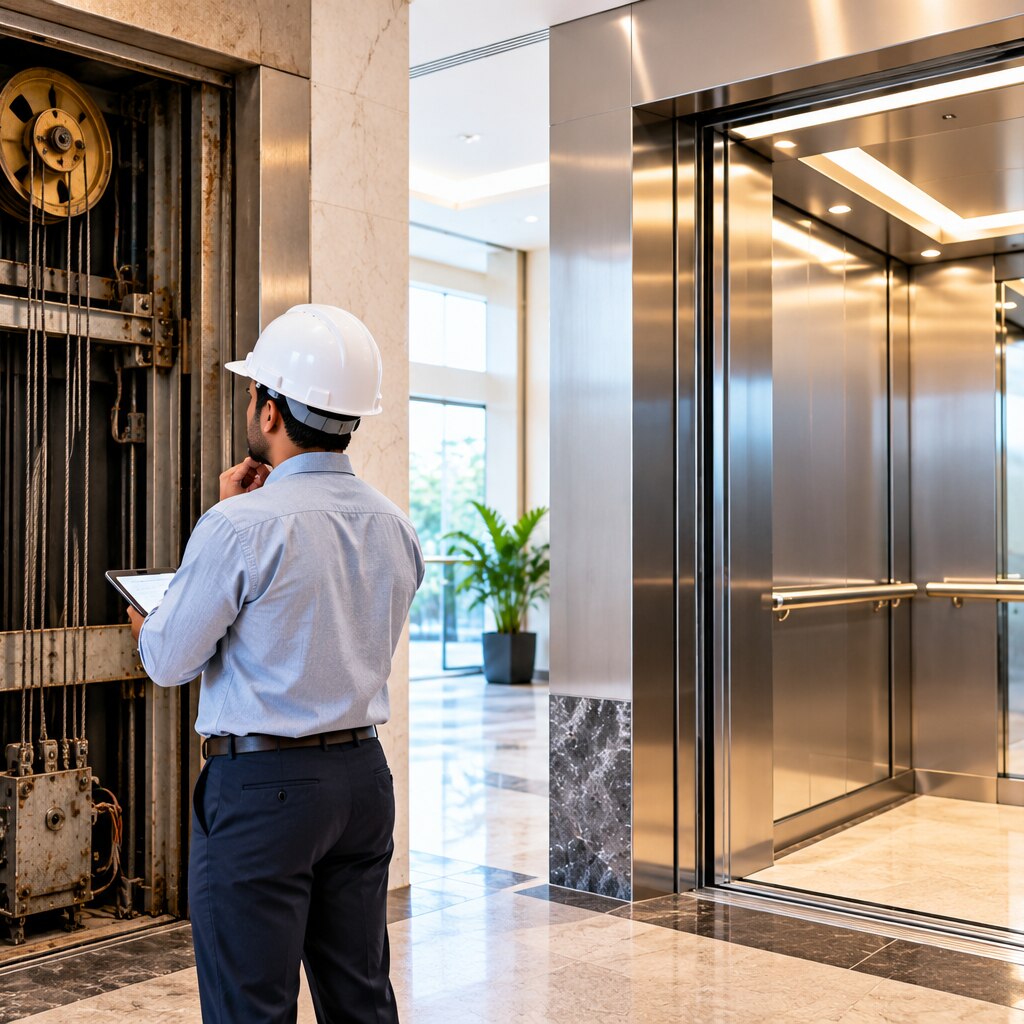
3. Inspect the retained equipment, not just the proposed controller. Record ride quality, leveling accuracy at every landing, door reopening, abnormal noise, vibration, emergency operation, and performance on backup power. A controller-only scope is weak when faults originate in brakes, ropes, guide rails, door locks, or a deteriorated machine.
Treat repeated uncontrolled movement, failed safety functions, unreliable emergency communication, or door-lock faults as safety decisions before budget decisions. If several major systems are reaching the end of service life together, replacement is more credible than a narrow upgrade.
For an elevator modernization decision, compare retained life against downtime, repair risk, and the cost of a second project. State every retained and replaced component before choosing whether to modernize or replace elevator.
Which conditions require shutdown or a replacement-level response?
Brake failure, uncontrolled elevator movement, or a failed door interlock requires an elevator safety shutdown, not another short-term adjustment. Isolate the car, restrict access, and obtain a competent safety assessment before anyone returns it to normal service.
| Condition | Required response | Why a narrow upgrade is inadequate |
|---|---|---|
| Brake failure, uncontrolled movement, or failed stopping test | Shut down; assess for replacement-level work | A new drive cannot correct a brake or traction-machine defect |
| Repeated leveling faults or damaged, misaligned guide rails | Shut down until corrected and retested | A trip hazard or poor guidance remains a safety defect |
| Failed landing-door lock, inaccessible safety circuit, or unverifiable overspeed or unintended-movement protection | Isolate the elevator | The car cannot be safely contained, stopped, or prevented from moving with doors open |
| Discontinued safety boards, programmed components, firmware, or diagnostic tools with no dependable supply | Plan replacement-level work | Future safety repairs depend on unavailable support |
Ask for test results covering brake stopping performance, governor operation, safety-gear engagement, door-lock circuits, terminal limits, buffer condition, and emergency battery and communication performance. Do not keep the car operating because a temporary adjustment restores service for a few days.
Inspect a hydraulic elevator’s pump, valve, tank, jack, cylinder, seals, and buried components separately. A new hydraulic power unit does not remove leakage, corrosion, environmental risk, or future replacement difficulty from a defective buried jack.
Retained traction equipment also requires evidence of sound condition: check the machine, sheave, rope grooves, ropes, rail fastening, and shaft alignment. If the defect affects containment, stopping, door locking, or emergency release, return the elevator to service only after the authority having jurisdiction and the responsible professional accept the corrective work.
Which equipment and building parts can you retain?
Modernization can retain sound equipment, but only after an elevator shaft survey confirms that the existing installation supports the proposed controls, clearances, and safety interfaces. Name every retained and replaced item in the specification.
| Item | Retain when | Replace when |
|---|---|---|
| Controller | Parts and diagnostics remain available | Safety boards or software are obsolete |
| Variable-frequency drive | Compatible with motor and encoder | Faults or data mismatch persist |
| Motor or machine | Tested, aligned, and serviceable | Insulation, bearings, or machine condition fails |
| Ropes and traction sheave | Diameter, wear, grooves, and alignment pass inspection | Cracking, stretch, or groove damage exists |
| Landing doors and car doors | Panels, locks, and guides remain sound | Damage or unreliable locking exists |
| Door operator | Reopens and levels reliably | Repeated faults or poor performance continue |
| Car operating panel and hall fixtures | Signals and controls can be upgraded | Wiring or accessibility prevents compliance |
| Wiring | Insulation and circuits test sound | Brittle, damaged, or incompatible |
| Governor and brakes | Tests verify stopping and overspeed protection | Stopping performance cannot be verified |
| Hydraulic power unit | Pump, valve, tank, jack, and seals are sound | Leakage, corrosion, or jack risk exists |
Inspect guide rails, brackets, pit, buffers, overhead, counterweight, machine room, landing openings, sill, feeder, disconnect, grounding, ventilation, water ingress, drainage, shaft lighting, and fire-rated construction.
Measure car dimensions, clear door opening, landing approach, sill gap, hall-station position, overhead, and pit depth. A controller cannot enlarge a car or hoistway opening. Test encoder feedback, motor data, brake monitoring, load weighing, door locks, fire service, inspection controls, and unintended-movement protection together.
A machine-room-less option requires separate checks for access, rescue, ventilation, electrical demand, and maintenance clearance. Retain traction or hydraulic equipment only with documented remaining service life.
How do approvals and outage planning change the choice?
A technically sensible scope fails if the authority will not approve it or the building cannot tolerate the outage. Before fixing specifications, establish the Indian elevator approval route and request:
- Adopted requirements for the project location and the authority having jurisdiction’s alteration rules
- Elevator modernization permit forms and prior inspection certificates
- Sanctioned drawings, load and electrical details, and test records
- Fire-service, emergency-power, emergency-communication, and building-management-system requirements
An alteration does not automatically require every existing part to be rebuilt. Each changed element must satisfy the adopted requirements and the authority’s inspection process. Confirm whether prior approval covers the controller and drive, doors, safety circuit, speed, machine relocation, structural work, or a new hydraulic package.
Put elevator inspection and testing into the contract. Require safety gear and governor, brake, door-lock, leveling, emergency-operation, fire-recall and firefighter-operation tests; backup-power transfer; alarm and communication; car-top inspection controls; and load testing.
| Option | Outage pattern | Practical condition |
|---|---|---|
| Phased modernization | Shorter outages per car | Works only when shared controls permit safe sequencing |
| Full replacement | One longer outage | Includes demolition, hoistway preparation, delivery, installation, testing, and approval |
Your elevator shutdown planning must cover temporary accessibility, notices, protected material routes, working-hour limits, alternate entrances, and access for people who cannot use stairs. A replacement is not automatically faster than staged modernization.
How should you compare the total cost and select the scope?
The lower quotation is not automatically the better elevator lifecycle cost. Build an elevator replacement cost comparison using total cost of ownership elevator: price equipment, dismantling, civil work, electrical work, permits, inspection and testing, freight, installation labour, temporary access arrangements, and future maintenance as separate lines.
| Option | Include in the comparison | Choose it when |
|---|---|---|
| Modernization | Retained equipment, replacement parts, enabling work, outage, maintenance, energy, inspection fees, and residual life | The structure and machinery have verified life and the upgrade removes the dominant risks |
| Replacement | New equipment, demolition, civil and electrical work, approvals, outage, commissioning, and long-term support | Retained assets would soon need another major expenditure or cannot meet safety, access, or serviceability requirements |
Add lost elevator availability, tenant disruption, generator or feeder upgrades, pit drainage, machine-room ventilation, fire-rated repairs, and structural work required by the selected dimensions. Include spare-part lead times, corrective repairs, and the risk of a second modernization in the elevator lifecycle cost.
Measure operating and standby energy. ISO 25745 includes lighting, displays, ventilation, controls, and door operators, so do not accept a motor-efficiency saving claim alone.
Request two scopes from every bidder: a condition-based modernization naming every retained component, and a replacement option listing demolition and enabling works. Require interface tests for the motor, encoder, brake, locks, load weighing, emergency systems, fire service, and building-management connection.
Ask Firefox Elevators Private Limited, alongside other qualified providers, to state exclusions, approval responsibility, outage duration, warranty, spare-part support, and maintenance response terms.
Related products
 | Elevators ₹5900 Elevator Door Sensors are advanced safety devices designed to detect obstructions and ensure seamless door operation. View product → |
 | Elevators Motors ₹95000 Discover premium elevator motors from Monadrive, Montanary, NBSL, and Technik Eesti. |
Frequently asked questions
What evidence supports modernizing an older elevator instead of replacing it?
Modernization is more defensible when the shaft, guide rails, car, machine, ropes, and major safety equipment remain sound, while failures cluster in obsolete controls or replaceable components.
Which elevator conditions require shutdown or a replacement-level response?
Shut down an elevator when inspection identifies an unsafe shaft, failed safety equipment, structural damage, dangerous door operation, severely deteriorated ropes, or another condition that prevents safe operation. Replacement becomes more appropriate when core equipment cannot be reliably repaired or integrated.
Which elevator equipment and building parts can be retained?
You can retain sound guide rails, the shaft, car enclosure, machine, ropes, doors, and safety equipment when inspection confirms their condition, compatibility, and remaining service life.
How should you compare elevator modernization and replacement costs?
Compare the full lifecycle cost, including equipment, structural work, approvals, downtime, temporary access arrangements, maintenance, energy use, and future component availability rather than comparing equipment prices alone.
Related products
 | Elevators Center Opening Auto Door ( Small Vision) ₹8500 Center Opening Auto Door (Small Vision) by Firefox Elevators Private Limited is a premium automatic elevator door solution designed for smooth... View product → |
 | Elevators Elevator Door Operator Controller ₹17700 The Elevator Door Operator Controller ensures precise and efficient operation of elevator doors, enhancing safety, reliability, and seamless... View product → |