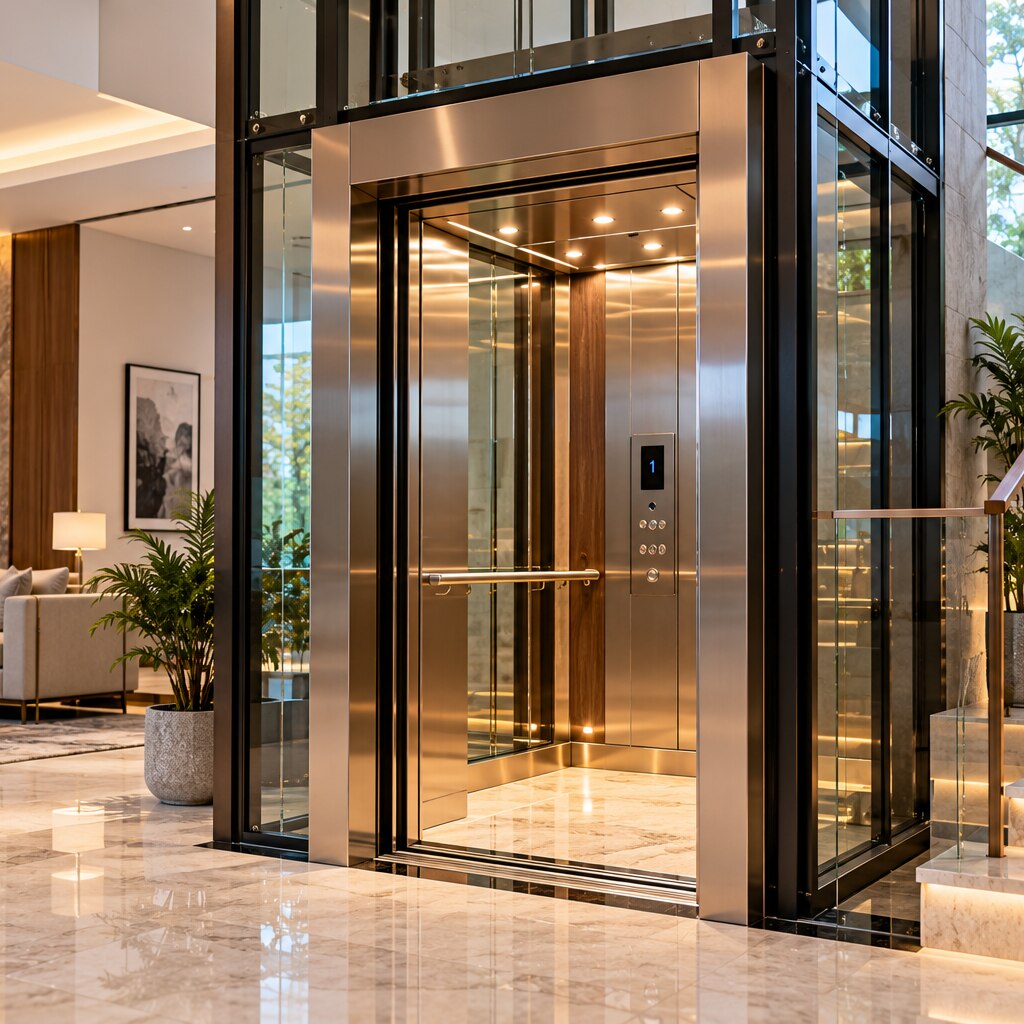
A luxury lift earns its place in a home through quiet movement, easy controls, useful dimensions, and finishes that remain practical after years of cleaning and repairs. You will be able to compare cabin layouts, lift technologies, materials, glazing, lighting, and installation requirements before approving a design.
Key takeaways
- Measure ride quality using ISO 18738-1, not appearance alone.
- Reserve space for the shaft, doors, controls, and safe maintenance access.
- Choose lift technology after checking pit, headroom, load, and power constraints.
- Demand test records, manuals, warranties, and safety documents at handover.
Which design features make a home lift feel genuinely comfortable?
A comfortable luxury home lift is defined by what you feel, hear, and operate, not by its marble or brass. Specify a smooth lift ride through recorded acceleration, jerk, vibration, stopping accuracy, and door performance, using ISO 18738-1 as the measurement framework.
| Feature | Comfort improvement | Decorative upgrade |
|---|---|---|
| Ride quality | Commissioned measurements for acceleration, jerk, vibration, leveling, and door timing | A higher nominal speed without better starts, stops, or leveling |
| Doors | Automatic doors, obstruction detection, quiet operators, and enough recess for maintenance | Concealed tracks or unusual door finishes that add no operating benefit |
| Cabin environment | Low lift cabin noise, vibration isolation from bedrooms, steady home lift ventilation, and glare-free lighting | Mirror walls, metallic trim, or colored glass that only changes appearance |
| Controls | Tactile buttons, readable contrast, reachable height, audible and visual indicators | A touch-screen panel that is slow, reflective, or unusable during a fault |
Ask for commissioning records rather than accepting “luxury” or “smooth” as claims. Test the lift with the doors opening and closing, several load conditions, and repeated stops at each floor; a beautiful cabin cannot hide a jarring landing or a noisy drive.
Treat equipment choice as part of comfort. An EN 81-41 platform lift is limited to 0.15 m/s, so it is the wrong specification when you need passenger-lift ride quality or faster travel. For passenger lifts, use EN 81-70 to check accessible controls and door operation.
Seating, handrails, ventilation, and controls that work without a touchscreen improve daily use; decorative finishes do not.
How should you size the cabin and position the shaft?
Start with the clear internal cabin size, not the advertised platform size. A wheelchair-friendly home lift needs room for the chair, a companion, and a door approach; a stroller, shopping bags, or luggage quickly make a compact cabin feel restrictive.
| Planning target | Clear internal cabin | Best suited to |
|---|---|---|
| Compact private lift | About 1000 × 1250 mm | One standing passenger, limited luggage, no wheelchair turning |
| Accessible everyday lift | About 1100 × 1400 mm | One wheelchair user with a companion and small bags |
| Generous family lift | About 1100 × 2100 mm | Wheelchair, stroller, luggage, or several passengers |
Treat these home lift dimensions as starting points, not promises. Ask for the clear door opening, internal turning diagram, shaft dimensions, pit, overhead, and landing space; a 1100 × 1400 mm cabin does not provide a 1500 mm wheelchair turning circle.
Choose a power-operated door with at least the clear opening required by your accessibility brief, then allow extra shaft width, door-recess depth, controls, and maintenance access.
Place the shaft beside the stair or another service core when this keeps bathrooms, wardrobes, and structural walls aligned on every floor. This lift shaft placement usually protects larger rooms from awkward corners and reduces sightlines into bedrooms.
Do not put the shaft across a window wall unless the lost daylight is acceptable. Before fixing it, draw door openings and landing approaches on every level, check furniture routes, and keep bedroom doors outside direct view of the lift. Home lift planning should protect privacy as carefully as floor area.
Which lift technology suits the building and installation constraints?
Choose among luxury home lift types by travel distance, daily traffic, acoustic target, pit depth, headroom, and access for maintenance—not by the cabin finish alone.
| Option | Speed and ride | Clearances, machinery, and disruption |
|---|---|---|
| Passenger lift | Highest speed and best stopping accuracy; automatic doors and guided traction give the most refined ride. | Needs a compliant shaft, pit, headroom, and refuge clearances. Traction equipment may use an overhead machine room or machine-room-less arrangement, with substantial structural work. |
| Hydraulic home lift | Smooth at low speeds and short travel, but acceleration and levelling depend heavily on control quality. | Requires a cylinder, buried or adjacent, plus a remote power unit and oil containment. Excavation and hydraulic pipe routes can disrupt floors. |
| Traction lift | Quiet, efficient, and comfortable across greater travel and repeated trips. | Requires counterweight space, guide rails, pit depth, and headroom; machinery and door recesses increase structural coordination. |
| Screw-driven lift | Slow, with audible motor and mechanical noise that can carry through adjoining rooms. | Avoids a counterweight and can suit compact shafts, but needs a screw, motor, supporting structure, and service access. |
| Platform lift | EN 81-41 limits rated speed to 0.15 m/s; it prioritises accessibility over passenger-lift ride quality and traffic capacity. | A low-pit home lift or platform arrangement can reduce excavation, but it still needs safety clearances, landing access, and controls. |
“ No pit” means shallow or altered below-floor work, not zero construction. Specify recorded acceleration, jerk, vibration, noise, stopping accuracy, and door operation under ISO 18738-1; use EN 81-70 when comparing platform lift versus passenger lift accessibility.
How should you judge finishes, glazing, and lighting beyond appearance?
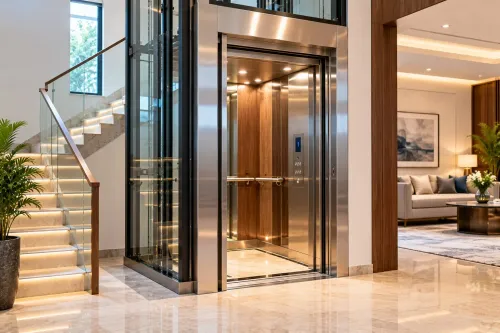
A durable finish is one you can clean, repair, and replace without dismantling the cabin. Powder-coated steel and compact laminate resist fingerprints, knocks, and household cleaning better than untreated wood or porous stone; use timber veneer or stone as removable panels, not structural surfaces.
| Choice | What to check | Why it matters |
|---|---|---|
| Glass arrangement | Laminated safety glass, secure edge protection, panel retention, and a documented replacement method | Full-height glazing adds mass, cleaning work, solar heat, and replacement risk |
| Metallic finish | Powder coating, PVD, or protected stainless steel; request a sample beside the handrail | Gold rosegold silver lift finishes show fingerprints and scratches differently |
| Floor and wall finish | Slip-resistant flooring, sealed joints, removable panels, and accessible fixings | Bespoke stone can obstruct repairs and increase lifting risk |
| Home lift lighting | Diffused, glare-free LED strips or downlights with replaceable drivers and emergency supply | Harsh spots reveal marks, while inaccessible drivers turn a small failure into a major repair |
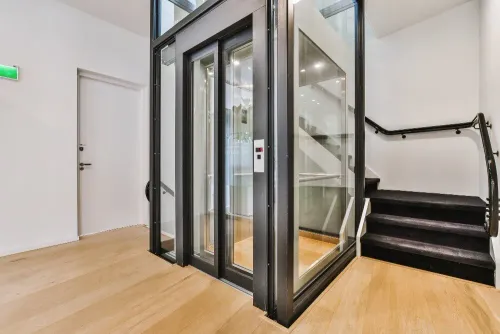
A glass home lift should state its glass construction and impact rating, not merely promise a “panoramic” cabin. Check how cleaners reach every pane and whether direct sunlight overheats the car.
Before approving luxury lift cabin finishes, require the maintenance layout under EN 13015: removable ceiling or wall sections, isolation points, lifting points, and service clearances. Also confirm that decorative materials do not imply fire-rated doors, smoke control, evacuation capability, or firefighter operation.
What should the final specification and handover documents prove?
A signed handover pack must prove what was installed, how it was tested, and how someone will be rescued or service the lift.
Do not accept “luxury home lift” as a safety classification: confirm whether the proposal is an EN 81-20 home lift or an EN 81-41 platform lift, limited to 0.15 m/s, and require EN 81-70 accessibility features when independent wheelchair use is part of the brief.
| Document | Evidence to require | Failure it prevents |
|---|---|---|
| Safety and rescue | Rated load, speed, door-lock tests, pit and headroom clearances, overspeed protection, manual lowering procedure, refuge arrangements, and EN 81-28 alarm test with lift-location identification and communications fallback | A trapped passenger waits without a working alarm or a safe rescue method |
| Performance | Commissioning records for acceleration, jerk, vibration, noise, stopping accuracy, and door timing, measured using ISO 18738-1 methods | “Smooth” becomes an uncheckable sales claim |
| Energy | Rated motor data plus measured running and standby consumption, with controls for lighting, ventilation, and automatic sleep mode | Decorative lighting and idle equipment inflate energy use |
| Maintenance | EN 13015 maintenance instructions, service schedule, fault codes, isolation points, removable panels, lifting points, and documented lift maintenance access | Bespoke stone, glass, or concealed operators make routine repairs hazardous or expensive |
Ask Firefox Elevators Private Limited, or any appointed installer, to mark every service clearance on as-built shaft and machine drawings.
- Obtain conformity documentation, wiring diagrams, warranties, spare-parts references, and inspection records.
- Require a witnessed emergency-rescue drill and alarm call before signing acceptance.
- Record the person responsible for 24-hour faults, response times, and planned maintenance visits.
Related products
 | Elevators ₹2000000 A home lift is an innovative solution that enhances mobility within multi-story homes. View product → |
 | Elevators ₹147000 by Firefox Elevators Private Limited are premium elevator cabin solutions designed to deliver elegance, comfort, durability, and advanced interior... View product → |
Frequently asked questions
Which measurements prove that a home lift is comfortable?
Ask for recorded acceleration, jerk, vibration, stopping accuracy, and door performance, measured using ISO 18738-1 as the framework.
How do you size and position a luxury home lift?
Start with passenger capacity, wheelchair or furniture needs, door arrangement, shaft dimensions, pit, headroom, and maintenance access before fixing its position.
How do you choose lift technology for a home?
Compare the available pit, headroom, machine-room space, electrical supply, travel height, noise targets, and maintenance requirements against each technology.
What should you check in lift finishes and glazing?
Check cleanability, slip resistance, scratch and impact resistance, glare, heat, privacy, fire performance, and access to lights and controls—not appearance alone.
Which documents should you receive at home lift handover?
Require test and commissioning records, safety certificates, wiring and layout drawings, operating and rescue instructions, maintenance schedules, warranties, and equipment details.
Related products
 | Elevators ₹70800 by Firefox Elevators Private Limited are premium elevator cabin solutions designed to deliver elegance, durability, and modern functionality for... View product → |
 | Elevators ₹70800 by Firefox Elevators Private Limited are premium-quality luxury elevator cabins designed to enhance the aesthetics and functionality of residential,... View product → |
 | Elevators ₹59000 by Firefox Elevators Private Limited are modern and elegant elevator cabin solutions designed to provide superior aesthetics, durability, and... View product → |
 | Elevators ₹9440 Full Glass Doors by Firefox Elevators Private Limited are modern elevator entrance solutions designed to provide a luxurious appearance, enhanced... View product → |