A hydraulic lift can look simple from the outside, but its performance depends on oil pressure, cylinder geometry, valve control, heat management and the building that contains it. By the end, you will be able to trace each operating sequence, distinguish the main hydraulic layouts, identify site constraints and decide when hydraulic equipment fits better than traction equipment.
Key takeaways
- Pressure multiplied by piston area determines hydraulic lifting force.
- Specify pit depth, headroom, travel, load and duty before choosing a layout.
- Hydraulic lifts suit low-rise buildings but have speed and travel limits.
- Compare energy use, space, ride quality and maintenance against traction lifts.
How a hydraulic lift raises, lowers and stops the car
A hydraulic lift working principle converts electrical power into oil pressure, then into piston force. Pascal’s law states that pressure in confined oil acts throughout the fluid; lifting force equals oil pressure multiplied by piston area. When that force exceeds the car’s load, the piston moves upward inside the cylinder.
- Raise: An electric motor turns the hydraulic pump, which draws oil from the reservoir and sends it through the control valve into the cylinder. Rising pressure pushes the piston upward, carrying the car through its sling and guide rails.
- Lower: The motor stops, and the control valve opens a measured return path to the reservoir. Gravity lowers the car and forces oil back through the valve; throttling dissipates descent energy as heat rather than recovering it.
- Stop: The valve closes when the car reaches the selected floor, while a check or holding function prevents reverse flow. The controller then meters small corrections for accurate leveling.
A pressure-relief valve limits excessive oil pressure instead of allowing a blocked circuit to overload. A flow-limiting or oil-line rupture device restricts uncontrolled descent, while an emergency-lowering valve provides a controlled escape route during a power failure. The exact safety devices and tests must follow the elevator code governing the installation.
The components and configurations that determine the layout
The reservoir and pump store and move hydraulic oil. An electric motor drives the pump; a control valve regulates oil entering or leaving the cylinder. The cylinder contains the piston, which supports the car directly or through ropes and sheaves.
Guide rails keep the car aligned, the car sling carries its structure, buffers limit overtravel at the pit, and an emergency lowering valve provides controlled descent during a power failure.
| Option | Construction | Choose it when | Main constraint |
|---|---|---|---|
| Direct-acting hydraulic lift | The piston connects mechanically to the car and rises through a cylinder, often buried below the pit. | You want a simple, efficient arrangement for low- to moderate-rise travel and have suitable ground conditions. | A deep bore creates groundwater, external-corrosion, casing-failure and leakage risks; commission a geotechnical and groundwater review. |
| Holeless hydraulic lift | Side-by-side or telescopic jacks sit in the hoistway or pit, avoiding a full-depth buried jack. | Drilling is restricted, groundwater is problematic, or you need to reduce subsurface work. | Jack geometry, seals, travel, car arrangement and maintenance access constrain the design. |
| Roped hydraulic lift | Sheaves and ropes multiply movement, so the cylinder travels less than the car; a 2:1 arrangement needs about half the car travel. | You need greater travel without an equally deep jack. | Reeving adds ropes, sheaves, guards and inspection points. |
A larger cylinder produces more lifting force at the same oil pressure, but requires more space and oil volume. Every configuration still needs accessible pump, reservoir, valve and electrical equipment; lower overhead does not eliminate the machine-room or pit clearances required by code.
Building requirements, operating limits and real applications
A hydraulic lift suits a low-rise building with short travel, moderate speed, substantial load capacity and low-to-moderate traffic. It becomes a poor choice when many cars run continuously, travel is long, or passengers expect high-speed service.
The building still needs a hydraulic lift machine room, usually beside the hoistway, for the pump, motor, reservoir, control valves and electrical equipment. Allow space for maintenance access, ventilation, oil containment and noise control; reducing overhead clearance does not eliminate this room.
The pit must provide enough pit depth for buffers, clearances, inspection access and the chosen cylinder arrangement. A buried direct-acting jack also requires a deep bore, so obtain a geotechnical and groundwater review before drilling. Groundwater, corrosion and casing failure can turn leakage into a major civil repair.
| Building and duty | Hydraulic fit | Main limitation |
|---|---|---|
| Low-rise, short travel, occasional service | Strong fit for homes, small offices and low-rise retail | Lower speed than many traction systems |
| Heavy loads, moderate travel, limited daily cycles | Fit for freight, parking and service lifts | Heat buildup requires correctly sized oil capacity and cooling |
| Long travel, many stops, continuous traffic | Usually unsuitable | Energy loss, slower service and inconsistent ride quality under heat |
| High-rise or high-speed passenger service | Poor fit | Traction equipment normally handles the travel and speed better |
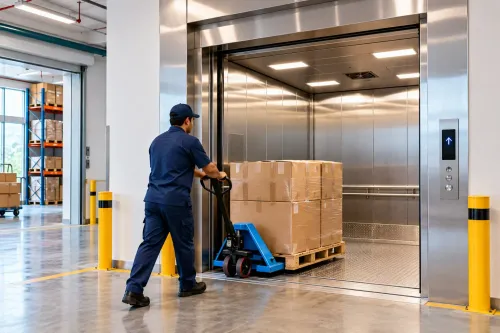
Common hydraulic lift applications include wheelchair access, low-rise commercial buildings, vehicle parking, warehouses and freight movement. Specify pressure relief, holding and flow-limiting protection, emergency lowering and abnormal-travel controls under the governing elevator code.
Hydraulic versus traction: the trade-offs behind the specification
The hydraulic vs traction lift decision turns on travel, stops, car load and duty cycle, not rated capacity alone. Hydraulic equipment suits low-rise service at moderate speed; traction equipment handles taller buildings and faster, busier operation.
Hydraulic lift | Traction lift Travel speed | Lower speed and shorter travel; best for low-rise buildings | Higher speed and longer travel; better for many floors Energy use | Pump motor runs on ascent, while descent throttles oil into heat; frequent cycles increase energy use and require cooling | Counterweight reduces motor load; variable-speed drives and regeneration can improve efficiency Space | Needs a machine room, pit equipment and space for a jack; holeless designs avoid deep drilling but constrain layout | Needs overhead clearance, counterweight space and machine equipment, although machine-room-less layouts reduce separate room area Ride quality | Smooth when oil temperature, valves and leveling are controlled; heat and seal wear can cause drift or rough stops | Consistent high-speed leveling, with rope stretch, sheave wear and drive tuning affecting comfort Installation disruption | Drilling for a buried cylinder can disturb foundations and groundwater; holeless systems reduce that work | Requires accurate rail alignment, overhead support and counterweight installation Maintenance | Inspect oil, seals, valves, cooling and leakage; high-cycle service stresses the power unit | Inspect ropes, sheaves, brakes, guides and drive equipment Frequent traffic | A small reservoir or weak cooling system overheats during hotel, hospital or parking service | Better suited to sustained traffic when its duty cycle and drive are correctly specified
Choose hydraulic equipment when compact low-rise service and heavy loads outweigh speed. Choose traction when rapid travel, intensive use and stable energy performance matter more.
What to inspect, maintain and specify before installation
Specify the acceptance checks before choosing an installer: a low price cannot compensate for an inaccessible power unit, undocumented oil, or a cylinder that cannot be inspected. Require drawings, component compatibility records, test procedures, maintenance intervals and a written response plan for oil leakage and entrapment.
1. Inspect the reservoir, pump unit, hoses, fittings, cylinder and pit for staining, drips, damaged seals and missing containment. Require compatible hoses and seals, accessible leak points, spill protection and a documented cleanup procedure; biodegradable or fire-resistant oil is not a drop-in replacement without confirming viscosity, lubrication and seal compatibility.
2. Specify the oil grade from the pump, valve and seal manufacturers. Require sampling or filtration after installation, contamination limits, air-bleeding instructions and temperature monitoring. Oil degradation, water, contamination and trapped air can cause pump noise, slow movement and spongy acceleration.
3. Test leveling with light and rated loads at different oil temperatures. Ask the installer to separate valve leakage, seal wear, thermal viscosity changes and pump adjustment from encoder, door-zone or controller faults. Repeated releveling is not fixed by a controller setting alone.
4. Specify a tested emergency lowering valve, pressure relief, check or holding function, oil-line rupture protection and independent means of reaching a safe landing during power loss. Record the test result and battery or manual-release maintenance requirement.
5. Name the governing jurisdiction and code in the contract. North American work uses ASME A17.1/CSA B44, with inspection and testing addressed in ASME A17.2; European projects commonly use EN 81-20 and EN 81-50, alongside local fire, accessibility and authority requirements.
For a modernization quotation, ask Firefox Elevators Private Limited to itemize valve, motor, pump, oil, seal, hose, jack-monitoring, controller and emergency-lowering work separately; a controls-only upgrade will not cure hydraulic leakage or contaminated oil.
Related product
 | Elevators ₹700000 The Hydraulic Elevator offers smooth, quiet, and efficient vertical transportation, ideal for residential, commercial, and industrial buildings. View product → |
Frequently asked questions
How does a hydraulic lift raise, lower and stop the car?
A pump sends oil into a cylinder, pushing the piston and car upward. Opening a control valve returns oil to the reservoir for descent, while the valve regulates stopping speed and floor-level accuracy.
What building requirements limit a hydraulic lift?
Check the required pit depth, overhead clearance, machine-room arrangement, travel distance, rated load, speed, ventilation and structural support before selecting the equipment.
When is a hydraulic lift preferable to a traction lift?
Hydraulic lifts suit low-rise buildings and applications where equipment-room placement or heavy loads matters. Traction lifts are usually better for taller buildings, greater travel and higher speeds.
What should you inspect before installation and during maintenance?
Inspect the cylinder, piston seal, hoses, valves, oil leaks, pump, electrical controls, door interlocks, emergency lowering system and car-level accuracy. Request load, travel, speed and maintenance specifications before installation.