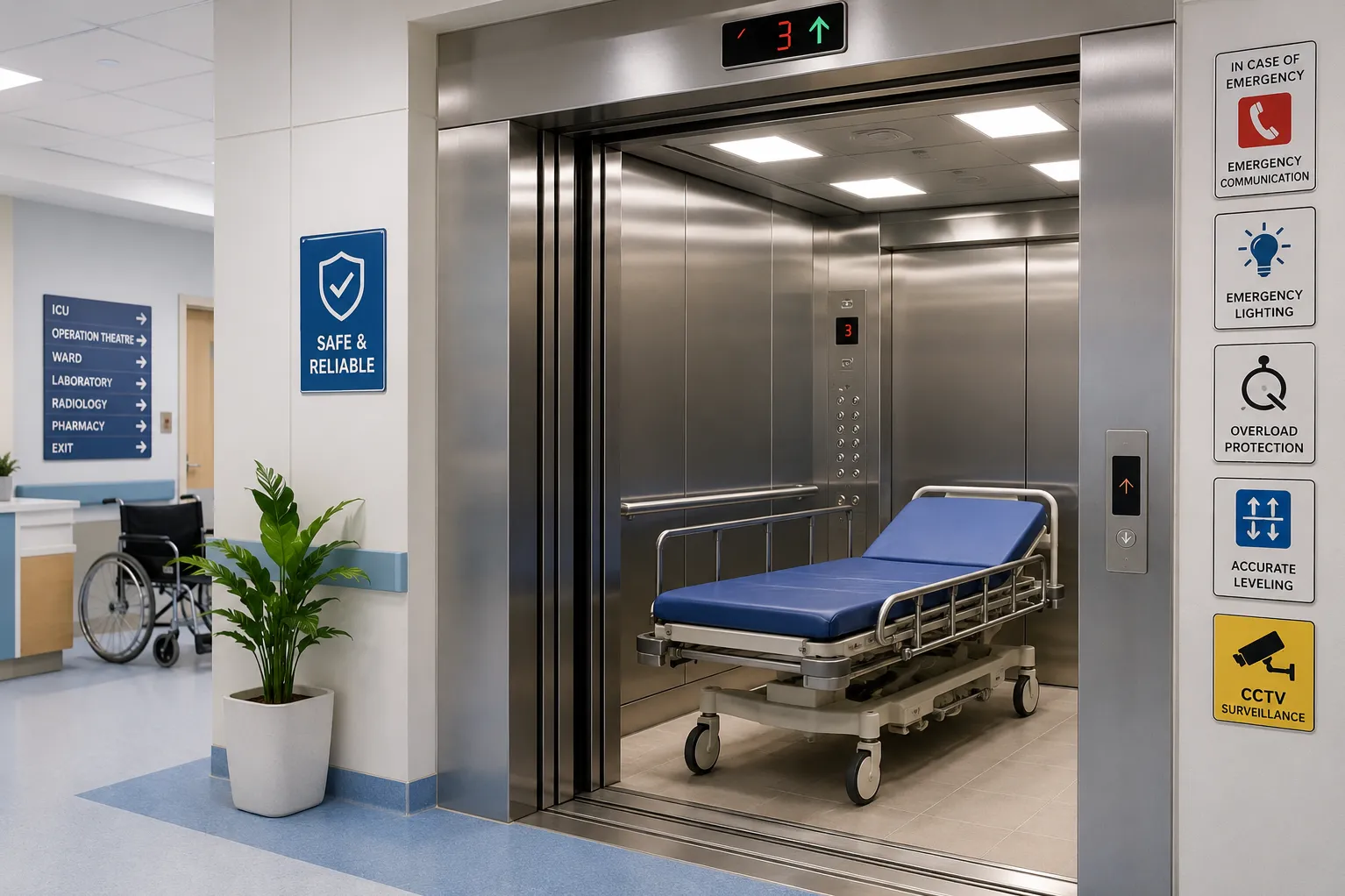
Elevators in healthcare facilities perform a more demanding role than ordinary passenger lifts. They may transport patients on stretchers, wheelchair users, medical personnel, equipment, attendants, and essential supplies throughout the day.
Hospital Lift Safety Starts With Proper Capacity
A hospital elevator needs enough cabin space and rated capacity for its intended application.
If stretchers or hospital beds will be transported, planners must consider their dimensions together with attendants and medical equipment.
Choosing capacity based only on passenger numbers can result in an impractical installation.
Essential Safety Considerations
Healthcare facilities should evaluate features and systems such as:
- Reliable door interlocks
- Overload protection
- Emergency communication
- Backup or emergency operation arrangements
- Accurate floor levelling
- Controlled door movement
- Appropriate emergency lighting
- Smooth starting and stopping
- Suitable cabin ventilation
- Easy-to-clean interior surfaces
The exact requirements should be determined according to the building and applicable standards.
Accurate Levelling Is Particularly Important
Small differences between the lift floor and landing can create difficulties when moving wheelchairs, stretchers, beds, and wheeled medical equipment.
Accurate levelling helps provide smoother entry and exit while reducing avoidable handling challenges for hospital staff.
Delhi Healthcare Facilities Need Traffic Planning
A busy multi-speciality hospital can have very different elevator traffic from a smaller nursing home or diagnostic facility.
Before finalizing specifications, consider:
- Number of floors
- Expected patient volume
- Peak-hour movement
- Bed and stretcher transportation
- Staff circulation
- Service requirements
- Emergency operating needs
Some facilities may benefit from separating patient, visitor, and service movement rather than depending on one elevator type for every purpose.
Maintenance Access Cannot Be Ignored
Elevator downtime is particularly disruptive in a healthcare environment.
Maintenance planning, component accessibility, preventive inspections, and emergency response arrangements should therefore be considered during selection rather than after commissioning.
For hospitals and healthcare projects in Delhi, Firefox Elevators Private Limited can evaluate building conditions, movement requirements, cabin capacity, and lift configuration before manufacturing and installation decisions are finalized.
A hospital lift should ultimately support clinical movement reliably while providing safe and comfortable transportation for patients, medical teams, and attendants.
Keywords